Global Competitiveness Index 4.0 (GCI 4.0)
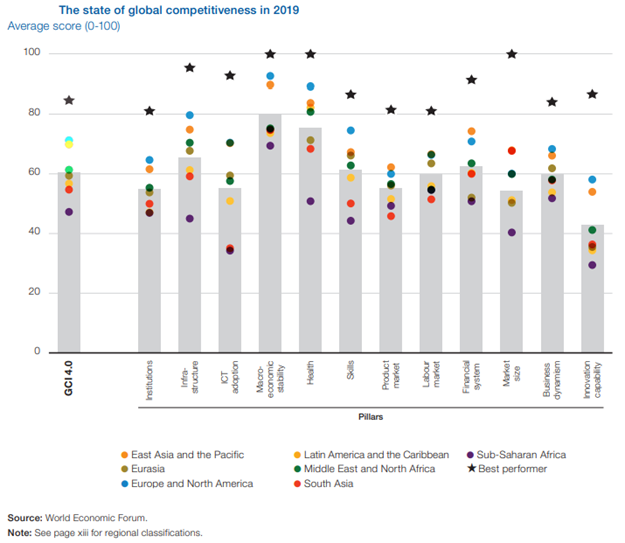
The report assesses 141 economies of the world based on the Global Competitiveness Index 4.0 (GCI 4.0) which reflects the countries ability to compete with each other in the era of the Fourth Industrial Revolution. Indicators, i.e. the primary requisites of long-term growth, are organized into 12 pillars: Institutions; Infrastructure; ICT adoption; Macroeconomic stability; Health; Skills; Product market; Labor market; Financial system; Market size; Business dynamism; and Innovation capability. A countrys performance is reported as a progress score on a 0-to-100 scale, where 100 represents the frontier, an ideal state where an issue ceases to be a constraint to productivity growth.
With a GCI score of 84.8 out of 100, Singapore is the country closest to the frontier of competitiveness. Among the G20, the United States (2nd), Japan (6th), Germany (7th) and the United Kingdom (9th) feature in the top 10, but they all have experienced erosion in their performance. Korea (13th), France (15th) and Italy (30th) are the only advanced economies to improve this year. Among the BRICS countries, China (28th) is the best performer, ahead of the Russian Federation (43rd), South Africa (60th), India (68th), and Brazil (71st).
Productivity-enhancing measures
The WEF experts believe that the global economy is ill-prepared for a downturn after a lost decade for productivity-enhancing measures. The average GCI score across the 141 economies studied is 60.7, meaning that the distance to the frontier stands at almost 40 points. Advanced economies perform consistently better than the rest of the world, but overall, they still fall 30 points short of the frontier.
Policy-makers must look beyond monetary policy to other policies, investments and incentives for reviving productivity growth. Investment-led stimulus appears as an appropriate action to restart growth in stagnating advanced economies. Finding a balance between technology integration and human capital investments will be critical to enhancing productivity. The GCI 4.0 reveals that in several countries with significant innovation and technological capabilities such as Korea, Rep., Italy, France and Japan, insufficient talent development may increase the risk of negative social consequences. Emerging economies with growing innovation capacity such as China, India and Brazil must also better balance technological integration and human capital investments.
The authors of the report conclude that policy interventions should focus on addressing the factors that can lead to improved productivity while reducing inequalities at the same time. The experts identify four promising areas for intervention: increasing equality of opportunities, fostering fair competition, updating tax systems and their composition as well as the architectures of social protection, and fostering competitiveness-enhancing investments.