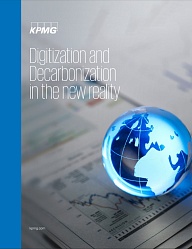
A research by consulting firm KPMG analyzes the impact of the pandemic on companies’ efforts to address their carbon footprint and implement principles of sustainable development through digitalization tools.
The Roscongress Foundation presents the salient points of the publication accompanied by fragments of broadcasts of relevant panel discussions from the business programme of international events held by the Roscongress Foundation.
The COVID-19 pandemic accelerated the introduction of digital solutions aimed, among other things, at developing ESG mechanisms and sustainable development strategies.
During the pandemic and mass lockdown, companies were forced to urgently implement digital solutions to enable remote working, meet consumer demand and reduce other costs. Such an «awakening» overlapped with a strengthened climate change agenda.
While the climate agenda used to be part of managers’ reports and a mandatory chapter in annual reports, today the close relationship between digital innovation and solutions to reduce the carbon footprint is already reflected in practice. According to several directors interviewed by KPMG, the evidence of climate risk is causing investors to reevaluate established views of modern finance and embed the notion of ESG mechanisms as inherent in their core.
The European Union, which is setting a new regulatory framework in the field of carbon regulation, has a particular influence on the promotion of this agenda. Because of this, businesses are forced to implement a new corporate strategy, where performance is closely intertwined with progress in sustainable development.
One of the key constraints in implementing corporate decarbonization strategies is the lack of accurate, objective and appraisable data.
According to the authors, the acceleration of digitalization will create the necessary tools to root decarbonization within the various lines of business of companies. The development of integrated data acquisition and aggregation mechanisms through various progress tracking metrics in the field of energy generation and carbon emissions will bring significant changes to production chains and, ultimately, increase added value.
The authors are convinced that the digital innovations introduced will have a large-scale impact on the geographical structure and methods of delivery within the framework of global value chains. The willingness of companies to change will provide such companies with a unique opportunity for change in areas such as transparency of production chains, faster time of bringing a product to market, reduction of the carbon footprint of production and product transportation, improved working conditions and social benefits.
Taken together, factors such as the pandemic, the acceleration of digital innovation, the decarbonization agenda, and external changes such as the USMCA trade deal between the US, Canada and Mexico offer companies (primarily from the US) a single, multi-generational opportunity to realign their production chains in favor of more sustainable ones. This is important both in terms of business processes and in terms of reducing the carbon footprint, especially by reducing the transport leg.
For more information, see the special sections of the Roscongress Foundation Information and Analytical System: Sustainable Development, Environment, COVID-19 devoted to the development of the environmental protection and decarbonization agenda, as well as the adaptation of companies in a post-COVID world.