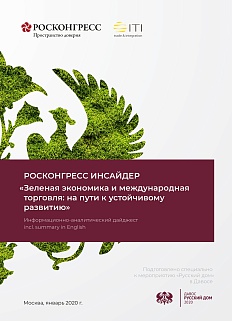
The report of the Higher School of Economics is devoted to the role and place of the environmental agenda in the domestic and foreign policy of Russia, implemented in a fundamentally changing world, including in interaction with key integration associations with the participation of our country (SCO, BRICS, EAEU).
The report was prepared by the team of authors of the Faculty of World Economy and World Politics, National Research University Higher School of Economics under the leadership of S.A. Karaganov based on the results of three situational analyzes under the auspices of the Russian Ministry of Foreign Affairs and with the support of the Roscongress Foundation, the Committee on International Affairs of the State Duma of the Federal Assembly of the Russian Federation, the Council on Foreign and Defense Policy and the magazine Russia in Global Affairs.
Analysts of the Roscongress Foundation have identified the main theses of this study, accompanying each of them with a relevant piece of video broadcasts of panel discussions held as part of the business programs of key events held by the Foundation.
Preservation and conservation of nature should be an important component of the Russian national idea, its mission for themselves and for the world.
Given the increasing urgency of environmental problems for the vast majority of countries in the world, there is a need to form a truly unifying, rather than dividing, non-discriminatory environmental and climate agenda that would stimulate the global movement to reduce environmental damage and reduce greenhouse gas emissions, and not form a narrow circle privileged country with minimal impact on climate change. Russia, with its richest natural potential and the position of the planet’s ecological donor, could become the initiator of such an agenda.
The modern environmental policy of Russia is not active enough and does not fully meet the challenges of the time, in particular, the sharp increase in the importance of the environment in the world economy and international relations, its transformation into a factor of competition, as well as the close fusion of the environmental agenda with the economic and technological.
Since the 1990s, environmental policy has been perceived in Russia as a burden, and sometimes as a threat to economic development. This is most clearly spelled out in the Economic Security Strategy of the Russian Federation (2017), where the development of «green technologies» is ranked among the main challenges and threats to the country’s economic security — primarily due to the fact that these technologies reduce the demand for raw materials exported Russia. Building foreign and foreign economic policy on the old pillars means accepting the fact that the role of Russia in the world economy and world politics will inevitably decrease.
The protection of nature should also become one of the priority areas of Russia’s foreign policy, an important part of the agenda of both Russia’s bilateral dialogues with key partners, primarily China and the EU, and multilateral institutions with Russian participation (BRICS, SCO, EAEU).
To date, due to disagreements between the member states, environmental and climate issues are not among the highest priorities within the BRICS and SCO frameworks. However, it is desirable for Russia to show leadership in this issue and to help gradually overcome differences and fill this gap, starting with a dialogue on the expert line. First of all, it should not be about the short-term obligations of the member states in the environmental sphere, but about jointly with Russia the development of a new global agenda in the field of environmental protection, fairer than the one proposed today by the West, and emphasizing the positive contribution of Russia to solving world environmental and climatic problems.
We also invite you to familiarize yourself with other materials posted in special sections of the Roscongress Information and Analytical System The National Project «Ecology», Climate Change, BRICS and SOC, dedicated to the development and enhancement of the role of the environmental agenda in domestic and foreign policy relations.