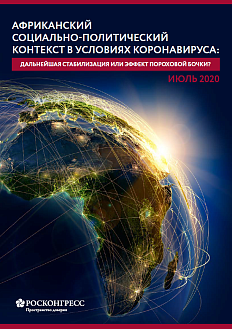
Issues of environmental, economical, military and political security in the Arctic are closely related, that renders impact of climate changes in the region fundamentally different as compared with the Antarctic. In the report the authors have analyzed impact of changing environmental, economical, military and political aspects of the Arctic security on the world community, specifically, the Netherlands.
The Roscongress Foundation presents the salient points of the publication accompanied by fragments of broadcasts of relevant panel discussions from the business programme of international events held by the Roscongress Foundation.
Situation in the Arctic region can be characterized by correlation of social, economic and global trends peculiar for the arctic ecosystem.
The Arctic region is heated three times faster than average global temperature a year. Temperature increase has already led to melting of glaciers and artic ice, transition of fixed water ice into seasonal and decrease of snow season. Climate change has a significant impact on arctic ecosystems.
The report also demonstrates relation between climate change in the Arctic and extreme weather events in the other regions, such as record winter temperature in the eastern part of the USA and the Northern Eurasia in 2018.
The report also notes, that although melting of arctic ice has a significant impact on geopolitical situation in the Arctic, global competition between major powers, i.e. China, Russia and the USA, has an increasing influence on the Arctic security.
The Arctic issue is still important for the Arctic and the Non-Arctic states worldwide.
The authors claim that environmental challenges open the largest opportunities for international cooperation, as all players shall understand that climate changes have an impact on unique environmental conditions in the Arctic region, and also how climate changes in the Arctic influence other parts of the world. It is important that environmental protection and sustainable development of the Arctic are indicated as key elements of the Arctic policy of all states in question. Local activities and key industries depend on the Arctic environment and resources. Therefore, such are exposed to risks due to changing environmental conditions. Next to that, the Arctic states emphasize sensitivity of traditional communities exposed to migration risks.
Although the Netherlands are a Non-Arctic state, the country is interested in the region and desires to play a significant role in its development.
In recent decades efforts of the Netherlands were focused on strengthening international cooperation, mitigation of climate changes and environmental protection of the Arctic, along with facilitating scientific research. In the Polar Strategy of the Netherlands for 2016-2020, it is noted that geopolitical measurement of the Arctic region is developing due to changes in the world order and is accelerated by glacier melting.
The report indicates that environmental, economic, military and political risks and opportunities for the Netherlands in the Arctic will be evaluated on the basis of these very interests in national security.
For more information about construction as a sector with a sizeable share in many economies, rising level of digitalization, and shifts in consumer sentiment in real estate, please see the The Arctic, Environment, Economic progress, Sustainable Development. Climate Change and Globalization/regionalization.