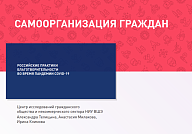
Experts from the Roscongress Foundation present a review of two articles included in the special edition of the Higher School of Economics ‘’HSE Analytical Bulletin on the Economic and Social Consequences of the Coronavirus in Russia and Globally’’. The articles focus on various volunteering practices that have spread during the COVID-19 pandemic. Thus, the article «Russian charity practices during the COVID-19 pandemic» examines examples of how commercial and non-profit organizations carry out their activities in the current realities. The article entitled «Non-profit Sphere Abroad during the Pandemic: Digitalization and Volunteer Activism» provides examples of how volunteering and the non-profit sphere adapt in harsh economic conditions.
Roscongress Foundation analysts highlighted the main theses of these articles, accompanying each of them with suitable fragments of video broadcasts of panel discussions held as a part of business programs of the key events hosted by the Foundation.
During the pandemic, Russian business and non-profit organizations (NPOs) often initiate charity events, provide financial and food assistance to those in need. At the same time, the main recipients of support are the most vulnerable groups of citizens, as well as staff of medical institutions.
In today’s difficult epidemiological environment, the provision of assistance (free of charge or on preferential terms) to those who need it is becoming particularly widespread. The main recipient of support is the staff of medical organizations. On their own initiative, Russian restaurateurs and chefs deliver food for free to hospitals for doctors and volunteers involved in the fight against the virus in the capital and other cities of the country. Large corporations provide technological and logistic assistance to doctors.
However, medical personnel are not the only recipients of support; many initiatives are aimed at supporting the most vulnerable groups of citizens. HSE experts give examples of projects that help to carry out free delivery of food sets to those in need. Volunteers travel to airports to deliver food to people temporarily staying in the neutral zone due to canceled flights and the inability to fly back home.
At the very beginning of the coronavirus crisis, non-profit organizations went through a period of adaptation, characterized by the search for new methods and ways of providing assistance, such as virtual volunteering. Now NGOs are entering a phase of deepening and improving remote social practices.
During the pandemic, such form of volunteerism as virtual volunteering became particularly relevant as it allowed volunteers to assist NPOs and people in need from home.
At the same time, the functionality that can be provided through virtual volunteering ranges from simple tasks, such as telephone consulting or online support of single elderly people, to highly professional issues, such as ensuring cybersecurity, in particular, of medical institutions.
The authors note that during the pandemic, commercial and non-profit organizations managed to channel available funds and capacities to support those in need. Many organizations have adapted and translated their activities online, and found ways to provide remote assistance. This includes an organization of online concerts and provision of free access to online cinemas.
These articles are part of the HSE Analytical Bulletin on the Economic and Social Consequences of Coronavirus in Russia and globally. You can find the full version of the publication here.
See other materials, placed in special sections of the Information and Analytical System Roskongress StayHomeEconomy, level and quality of life and volunteering, dedicated to possible ways to stabilize the economy in a pandemic, as well as the promotion of initiatives related to socio-economic development of the state.