The third issue of the annual State of Remote Work report by Buffer and AngelList studies the opinions of remote workers concerning positive and negative sides of remote work. Remote workers name ability to have a flexible schedule and flexibility to work from anywhere as the biggest benefits. Communication and collaboration continue to be top challenges for remote workers and remote organizations. With distributed teams, misunderstandings and poor teamwork may become a common problem leading to low efficiency. This finding shows that many existing digital communication tools arent effective enough and highlights the need for collaboration tools optimized for remote teams.
The Roscongress Foundation presents the salient points of the publication accompanied by fragments of broadcasts of relevant panel discussions from the business programme of international events held by the Roscongress Foundation.
The respondents almost unanimously want to work remotely and would recommend remote work to others.
In 2020, the results of the survey done by Buffer and AngelList show that 98 percent of respondents want to continue working remotely. The authors of the report note that this statistic remains unequivocal each year. Also, 97 percent of respondents said they would recommend remote work to others.
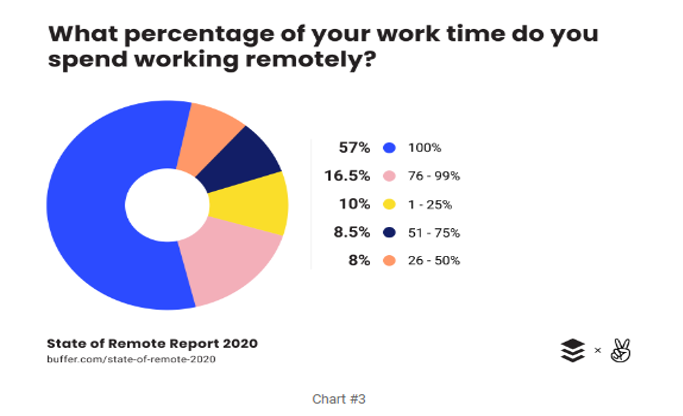
Meanwhile, although most remote workers would like to work remotely full-time or as often as possible, the reality is different. The results of the survey show that as few as 57 percent of respondents are full-time remote workers, and another 27 percent work remotely more than half of their time. The smallest group (18 percent) works remotely for less than half of their time: 8 percent spend 26 to 50 percent of their work time working remotely, and with 10 percent of remote workers its 1 to 25 percent of work time.
Still, the vast majority of respondents (70 percent) indicated that they were content with the amount of time that they currently work remotely. 19 percent would like to work remotely more often, and 11 percent would like to work remotely less often.
Ability to have a flexible schedule and flexibility to work from anywhere are the biggest benefits of remote work.
Having a flexible schedule has consistently remained the most chosen benefit for remote workers across all the three annual State of Remote Work surveys. This year, the analysts added a benefit of «not having to commute» to the list. Unsurprisingly, this benefit made the top three. The authors of the report point out that there is much research showing that commuting often causes more stress than actual jobs.
Flexibility to choose work location is another commonly named benefit. Home is consistently the number one primary work location for remote workers (80 percent of responses). Another consistency is that when people arent working from their homes, they choose to work from coworking spaces (7 percent) or coffee shops (3 percent).
Coffee shops are growing in popularity as a secondary work location. Although only 3 percent of respondents primarily work from coffee shops, 27 percent choose coffee shops as their secondary work location. The authors of the report link this trend with remote workers aversion to commutingpresumably, respondents favour local coffee shops. One other benefit of remote work is the ability to spend time with ones family.
Communication, collaboration, and loneliness are top challenges for remote workers and remote organizations.
Having studied relationships between employers and remote workers over the past three years, the authors of the publication identified main problems associated with remote work. The majority of respondents name difficulties with collaboration or communication (20 percent) and with loneliness (20 percent) as the biggest challenges of remote work.
Experts say that, even with hundreds of digital collaboration tools available now, the challenge of effective communication may remain, especially when the company isnt all-remote and some employees remain office-based. If everyone on the team isnt communicating in the same ways, misunderstandings and poor teamwork may become a common problem lowering efficiency. Real-time tools (such as real-time chats) can be especially challenging if teammates are located in different timezones. This too has an adverse effect on overall productivity. At the same time, experts believe that these challenges will trigger emergence of collaboration tools optimized for remote work.
Another constraining factor for remote work is that companies are unwilling to cover their employees remote-work-related expenses (such as home internet bills, coworking space memberships, and cell phone bills).
For more information about possible ways to stabilize the economy during a pandemic, please see the StayHomeEconomyspecial section of the Roscongress information and analytical system, and the Labour productivity gains and Entrepreneurship sections about measures aimed at stimulating economic progress.