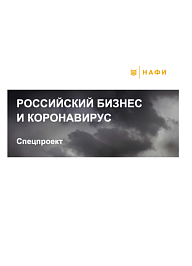
NAFI Research Centre has prepared a special research project titled Russian Businesses and the Coronavirus. The study consists of three parts and is based on a survey of entrepreneurs all over Russia conducted by NAFI in March and April 2020. The first part of the study describes the impact of the coronavirus pandemic on the Russian economy and assesses the necessity of state support for Russian businesses. The second part studies how the need to cut operating costs affects the companies’ staff. The third part is focused on lease payments studying their affordability and the relationships between business owners and lease providers.
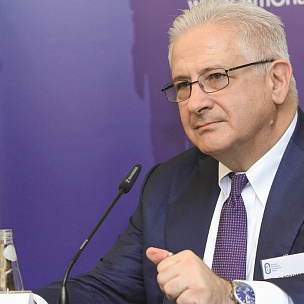
The Roscongress Foundation presents the salient points of the publication accompanied by fragments of broadcasts of relevant panel discussions from the business programme of international events held by the Roscongress Foundation.
Overview of the first part of the Russian Businesses and the Coronavirus project. What entrepreneurs say about the impact of the pandemic on their business and about the need for state support
In the first part of the Russian Businesses and the Coronavirus special project, NAFI studies the companies’ need for state support.
The results of the study show that as early as in mid-March Russian business owners began to face difficulties and that they aren’t feeling hopeful about the prospects for their business in the near term.
Most entrepreneurs are pessimistic about how soon the situation in their industry will return back to normal. Nearly a half of the respondents (43%) believe that the situation will normalize no sooner than a year from now, while 14% think that it will take at long as two to three years. The pessimists mostly represent companies that were set up before 2010 and, consequently, have already suffered economic crises. One-third of entrepreneurs (31%) believe that the situation will be back to normal within several months. The optimists are mainly young people aged below 30 (47% against 26% of entrepreneurs aged over 50).
Concerning state support, business owners mostly name tax holidays or zero taxes as measures of primary importance. Also, entrepreneurs urge the government to provide subsidies or other means of financial support, introduce lease and loan holidays, offer zero-interest loans for maintaining business operations, and reduce or cancel mandatory social insurance contributions.
See full text of the «What entrepreneurs say about the impact of the pandemic on their business and about the need for state support» study on the official website of the project:
https://nafi.ru/upload/SP_Business%20and%20coronavirus_P1.pdf
Video: https://roscongress.org/sessions/biznes-navigatsiya-po-rossii-delovoy/search/#00:05:29.471
Overview of the second part of the Russian Businesses and the Coronavirus project. Human capital: Staff cuts and remote work
In the second part of the Russian Businesses and the Coronavirus project, NAFI studies the impact of the pandemic on HR decisions.
The results of the study show that in the context of the self-isolation regime Russian companies reduce staff costs by putting employees on unpaid leaves, reducing salaries, and cancelling bonuses and benefits. One-third of companies switched to remote working. However, the majority are unwilling to retain this work format after the end of the lockdown, mostly because of low efficiency of staff in this format.
Russian entrepreneurs are faced with the following challenges:
· lack of HR management skills in remote work format, which affects overall effectiveness;
· insufficient readiness for a switch to remote work due to both low development of digital technologies and staff’s lack of relevant skills (i.e. low digital literacy in Russia).
See full text of the «Human capital: Staff cuts and remote work» study on the official website of the project:
https://nafi.ru/upload/SP_Business%20and%20coronavirus_P2.pdf
Overview of the third part of the Russian Businesses and the Coronavirus project. Relationships between lessors and lessees: In search for a compromise
In the third part of the Russian Businesses and the Coronavirus project, the analysts study the effect of the coronavirus pandemic on the affordability of lease payments for commercial property and describe the relationships between lessors and lessees in the current conditions. The results of the study show the following:
· 60% of business owners already have lease arrears because of the crisis;
· 85% have tried to renegotiate the terms of their lease contracts;
· 28% received a refusal from lease providers to renegotiate the contracts.
Lease payments are one of the primary items of expenditure for SMEs. So, prolonged lack of compromise concerning lease payments is a time bomb as it may result in numerous corporate disputes and lawsuits which carry a risk of bankruptcies or business closures.
As the crisis is evidently a temporary phenomenon, maintaining strong business relationships is a crucial factor for companies’ recovery. Consequently, constructive dialogue between the lessor and the lessee is obviously a preferable strategy.
The authors of the study conclude that the current trends will lead to a change in the leasing market. Changes will differ depending on the segment but at least a rise in vacancy rate (due to companies moving to cheaper facilities) and a fall in lease rates are definitely to be expected in the medium term.
See full text of the «Relationships between lessors and lessees: In search for a compromise» on the official website of the project:
https://nafi.ru/upload/SP_Business%20and%20coronavirus_P3.pdf
For more information about possible ways to stabilize the economy during the pandemic, please see the StayHomeEconomy special section of the Roscongress information and analytical system, and the Entrepreneurship and SMEs sections about measures aimed at supporting entrepreneurship and exports.