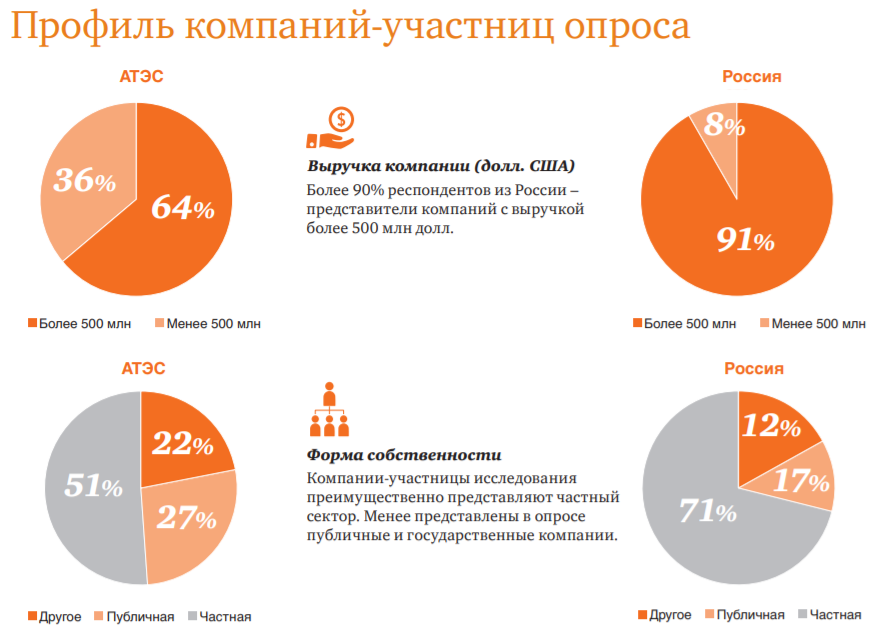
As part of this project, PwC analysed the views of the largest companies CEOs on a number of important issues, such as the prospects for business and investment expansion, technology development trends, and roles of CEOs in successful automation of business processes. The main topics of this years survey were the labour market and future labour force, creation of an operating model favorable to free trade, prospects for economic growth of the region in 2018, transition to digital technologies and the role of the APEC in addressing priority issues. 61 business leaders from Russia took part in the survey.
The review was first presented at the APEC-2017 summit in Da Nang, Vietnam.
1. In general, Russian CEOs are optimistic enough about their business profitability. Compared to 2016, the confidence of Russian business leaders increased by 10%: in 2017, 88% of respondents were confident in the prospects for the development of their companies.
2. More than half of the Russian respondents (54%) plan to increase their investments at the international level, and 66% of their investments will be made to the APEC countries. In their view, the APECs role is to ensure free trade and labour mobility between member countries participating the forum, as well as to increase the sustainability of the supply chain. However, 53% of Russian respondents are of the opinion that there has been no significant progress in free trade in the region over the past 12 months. For Russian companies to expand their presence in the region, they should develop business by creating partnerships and joint ventures. Strategic partners and suppliers should be selected according to Russian CEOs on the basis of industry experience, quality and price of a product or service, and sale opportunities.
3. In order to adapt quickly and painlessly to changes in the digitalisation times, business leaders transform many processes within their companies. Russian CEOs, like those of the APEC companies, are increasing investments in staff training and development of motivating programs aimed at independent professional growth of specialists, strengthen intra-industry interaction and focus on more flexible forms of employment (outsourcing).
4. According to Russian CEOs estimates, in 2017 the rouble will weaken against the USD by 5%. However, the expectations of Russian CEOs regarding the USD against the CNY are just the opposite: 57% of respondents believe that the Chinese national currency will strengthen against the USD by 5% in the next 12 months.