Freshwater scarcity: Gravity of the problem
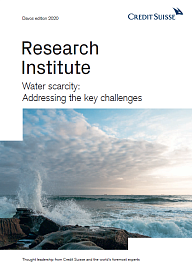
Water covers 70% of the Earths surface. However, usable freshwater accounts for as little as 3% of the entire worlds water. Over two billion people still live in countries experiencing high water stress, while four billion people experience severe water scarcity for at least one month a year. According to Credit Suisse, by 2030 a 40% supply-demand gap can be expected.
Water scarcity, and the societal risks it poses, is one of the primary challenges faced by the world today. Water scarcity is one of the key areas of focus as part of the UNs Sustainable Development Goals (SDGs) and addressing the consequences of the problem is central to six of these SDGs.
Factors driving water demand
With total water consumption set to see structural growth for decades to come, the report finds three factors driving water demand:
- Population growth.
- Urbanization.
- Rise of the emerging middle class.
Need for a global approach to the problem of water scarcity
Water supply, measured using renewable internal freshwater resources, is typically very static as renewable resources are low in many countries. According to Credit Suisse, part of the reason why the issue of water scarcity has not received the necessary attention from the global community to date might be because water scarcity is perceived as a more local issue than climate change. For example, high water stress in areas like North Africa and the Middle Eastern countries doesnt seem surprising, given their climate and geography, so the problem doesnt receive due global consideration.
While acknowledging the regional nature of the water-scarcity problem, the authors of the report underline the need for a coordinated global approach to address water stress.
Climate change and water stress: Strong linkages
Water stress and climate change are intrinsically linked not least because disruption to rainfall patterns is a direct, incontrovertible result of climate change. The implications are two-fold. One is an immediate disruption: increased droughts, floods and temperatures. The other is a more permanent, systemic effect where increases in water vapor in the atmosphere increase heavy downpours and, ultimately, soil erosion.
The authors of the report note that actual water availability is impacted by projected increases in both flooding and drought going forward. Increased flooding puts up to 1.6 billion people at risk by 2050. However, compared to the sporadic impacts of flooding, drought is a chronic, long-term issue, and arguably the most pernicious result of climate change. Meanwhile, the number of droughts globally is up by five times since 1950.

Source: Emergency Events Database (EM-DAT)
Estimated water infrastructure investment requirements
Water infrastructure requires substantial capital investments. On many of these investments the minimum acceptable rates of return are not met due to low water pricing in many regions. Meanwhile, despite the price/value mismatch (especially if environmental costs are incorporated), the current ability to price water is significantly constrained and regulated.
Estimates of the required investment in global water and sanitation infrastructure by 2030 vary considerably from USD 7.5 trillion (McKinsey 2016) to USD 23.1 trillion (New Climate Economy Report, 2014). An OECD technical note reviewing varying forecasts, estimates a USD 13.6 trillion cumulative investment requirement (2015 USD, 20162030).
Currently, investment in water infrastructure remains insufficient and very low compared with investments in other types of infrastructure. As an illustration, Credit Suisse provides investment figures for water, ICT, energy, and transport infrastructure in emerging markets.

Source: World Bank, Credit Suisse estimates