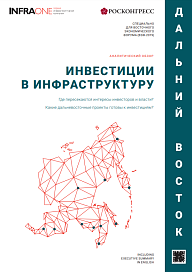
According to the authors of the publication, though strategic planning documents have built up the Far Eastern District the reputation of a special territory, in practice the government has no intention of greatly increasing investments over the next few years. The Comprehensive Infrastructure Development Plan at the present stage provides no more than 3% of expenditures for this territory. Besides, major investments will only be possible in case megaprojects are approved, for example, the construction of a bridge to Sakhalin.
In 2018, budget expenditures on infrastructure in the regions of the Far East rose in nominal terms for the first time in the past three years to RUB 93.4 bln, or by almost 11% compared to the previous year. Their share in the GRP of the district, on the contrary, decreased from 1.99% to 2.2% in 2017. The growth and the reduction are connected with the inclusion of Buryatia and Trans-Baikal Territory into the federal district. The leading regions in terms of infrastructure investments are Sakhalin Region, Khabarovsk Territory and Yakutia. They attract over 60% of all investments. In 2018, the gap between the leading regions narrowed, with Khabarovsk Territory even overtaking Yakutia. Jewish Autonomous Region remains the outsider in terms of investments. In Magadan Region investments fell to one-third of the former value. The InfraONE analysts don’t expect any significant shifts in the leading districts or a reduction of the gap between them and lagging regions of the Far Eastern Federal District in the next two or three years. According to InfraONE estimates, the minimum additional requirement for the Far East infrastructure in 2019-2021 amounts to approximately RUB 150-180 bln, or about 5-6% of the total Russia’s requirement. After 2020 the minimum requirement for the Far Eastern Federal District will probably grow by 12-15% per year. By 2022 the district will need RUB 350-355 bln for development.
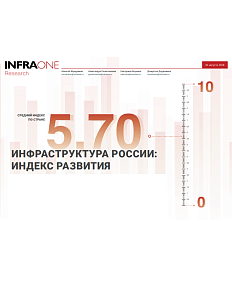
The infrastructure development index of the Far Eastern Federal District based on 2018 indicators fell below Russia’s average level (5.44 and 5.59 respectively), while in the previous year the indices of the district and the country were equal at 5.7. This indicator was negatively influenced by the integration of Buryatia and Trans-Baikal Territory in the Far Eastern Federal District. In the authors’ opinion, it is unlikely that the district will return to the average level or surpass it in the next two years at the very least. Chukotka Autonomous Area, Kamchatka and Khabarovsk Territories as well as Sakhalin and Magadan Regions remain the only ones which rank slightly above the national average level. In the Far East only the social infrastructure is developed better than the Russian average level: 5.68 against 5.42. However, this is a formal achievement because it is basically a result of out-migration rather than investments in the industry. Transportation lags far behind again. Within the year the gap has increased, and the district showed the country’s worst result of 2.90. To compare, the national average transportation infrastructure development index is 3.21.
Since the adoption of the Concession Law, 33 agreements of this type (with contract value exceeding RUB 100 mln) have been concluded in the Far East. The total amount is almost RUB 80 bln, which is 10% in terms of the number of projects and 10.8% in terms of the investment volume of the country’s concession market. Buryatia is the most active in use of public-private instruments. There are six projects in the region, followed by Kamchatka Territory and Sakhalin Region with five concessions in each region. Khabarovsk Territory (RUB 37.9 bln) and Amur Region (RUB 24 bln) have raised the largest volumes of investments.
According to InfraONE estimates, 29 projects with a total value of about RUB 817.7 bln are currently at an advanced stage in the Far-Eastern pipeline. Most of these projects are related to roads and housing and public utilities (five projects in each category, amounting to RUB 215.6 bln). However, rail transportation requires more investments — RUB 540 bln for the single project of the construction of the bridge to Sakhalin. Pipeline projects’ potential to be launched is comparable to the national average, although this is not very optimistic (just 2.4 out of 5). So, InfraONE expects a maximum of seven projects with a total value of RUB 26.1 bln to be launched in the Far East in the next year.
Close