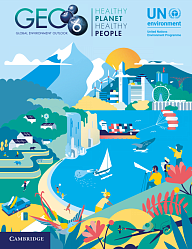
The United Nations Environment Programmes sixth Global Environment Outlook (GEO-6) is the most comprehensive report on the global environment since 2012. It shows that the overall environmental situation globally is deteriorating and the window for action is closing.
.png)
Unsustainable production and consumption patterns and trends and inequality, when combined with increases in the use of resources that are driven by population growth, put at risk the healthy planet needed to attain sustainable development. Those trends are leading to a deterioration in planetary health at unprecedented rates, with increasingly serious consequences, in particular for poorer people and regions. Furthermore, the world is not on track to achieve the environmental dimension of the Sustainable Development Goals or other internationally agreed environmental goals by 2030; nor is it on track to deliver long-term sustainability by 2050. The authors of the report elaborate on existing global environmental issues, such as air pollution, biodiversity loss, overexploitation of natural resources, illegal wildlife trade, marine plastic litter, land degradation, antibiotic-resistant infections, etc.
.png)
According to the authors, the social and economic costs of inaction often exceed the costs of action and are inequitably distributed, often being borne by the poorest and most vulnerable in society, including indigenous and local communities, particularly in developing countries. Current environmental policy alone is not sufficient to address those challenges. Urgent cross-sectoral policy action, through a whole-of-society approach, is needed to address the challenges of sustainable development. The key features of effective environmental policies for sustainable development include integrated objectives, science-based targets, economic instruments, regulations and robust international cooperation.
Food, energy and transport systems, urban planning and chemical production are primary examples of systems of production and consumption that need innovative, effective and integrated policies. Innovation in and deployment of technologies to reduce greenhouse gas emissions and increase resource efficiency can strengthen the economic performance of enterprises, municipalities, countries and other stakeholders. Sustainable development is more likely to be achieved through new modes of governance and adaptive management that give greater priority to the environmental dimension of the Sustainable Development Goals, while promoting gender equality and education for sustainable production and consumption.
The authors note that these new sustainability governance models should also ensure adequate investment in knowledge systems such as data, indicators, assessments, policy evaluation and sharing platforms, and act on internationally agreed early signals from science and society to avoid unnecessary environmental impact and costs. Data from satellites, combined with monitoring on the ground, can enable quicker actions across the world, in response to extreme weather events, for example. Harnessing the ongoing data and knowledge revolution and ensuring the authenticity and validity of those data to support sustainable development, combined with international cooperation, could transform capacities to address challenges and accelerate progress towards sustainable development. According to the authors, the most important of all is the need to take bold, urgent, sustained, inclusive and transformative action that integrates environmental, economic and social activity to set society on the pathway to achieving the Sustainable Development Goals, multilateral environmental agreements, internationally agreed environmental goals and other science-based targets.