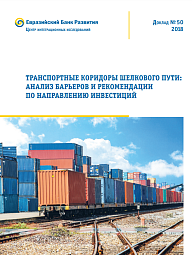
Restrictions discussed in the report prepared by the Centre for Integration Studies of the Eurasian Development Bank include infrastructural (transport and logistical infrastructure), border/customs-related, and administrative/legal barriers. The authors also provide recommendations regarding removal of barriers that hamper international freight traffic along the China-EAEU-EU axis.
One of the most critical infrastructure restrictions is the insufficient transport capacity of Polish railways, including crossing points at Belarus-Poland border. Difference in the length of container trains is another constraint for the development of transcontinental transit along the China EAEU EU axis. The main administrative and legal barrier to the increase of freight traffic among the China, EAEU, and the EU is the lack of unified shipping documents and technical regulations. Efforts are needed at the level of Greater Eurasia to implement a coordinated freight rate policy and standardise normative documents and technical regulations (rules for shipping various types of cargoes, rolling stock parameters, environmental standards, etc.).
To eliminate barriers to international freight traffic, it is very important for the countries hosting the main container transport routes to share long-term mutual railway traffic growth forecasts. According to the authors of the report, no mega projects are required to increase the transport capacity of land corridors along the China EAEU EU axis and boost their competitiveness compared to sea routes. Instead, what is needed is the selective elimination of transport infrastructure bottlenecks, which can be managed with limited investments: construction of additional railways, electrification of some railway sections, upgrade and modernisation of locomotive fleets, acquisition of special rolling stock, improvement of border crossing infrastructure, etc.
The report proposes a range of promising areas for investment in the EAEU countries:
- investment in alternative East-West container train routes (expanded use of the St. Petersburg transport hub and of Kaliningrad Regions transport and logistics infrastructure);
- establishment of nodal transport and logistics centres in Russia, Kazakhstan and Belarus;
- enhancement of international freight traffic with the use of special containers/cars (for chemical and mineral cargoes) and refrigerated containers (for food products).
A survey of European consignors has shown that efforts are needed to promote the use of trans-Eurasian freight traffic routes along the China EAEU EU axis. This will help to attract additional shipments from the EU to China and reduce the share of empty return containers. For the time being, European companies lack information about the advantages and terms of using trans-Eurasian land transport corridors (delivery times, transport modalities, door-to-door delivery, delivery costs), the level of their development, and existing routes (primarily railway ones).
.png)