The concept of Industry 4.0 is on the agenda and involves the sheer digitalization and integration of these value chains. Digital transformation requires a coordinated and focused work of top management and all companies divisions while taking into account the previously developed strategy. The study developed a digital maturity index for companies, based on which companies were divided into four groups: Digital Beginners, Digital Followers, Digital Innovators, and Digital Champions. Transformation recommendations are developed through the prism of the main levels of the ecosystem: Solutions for customers, Operations, Technologies and Personnel.
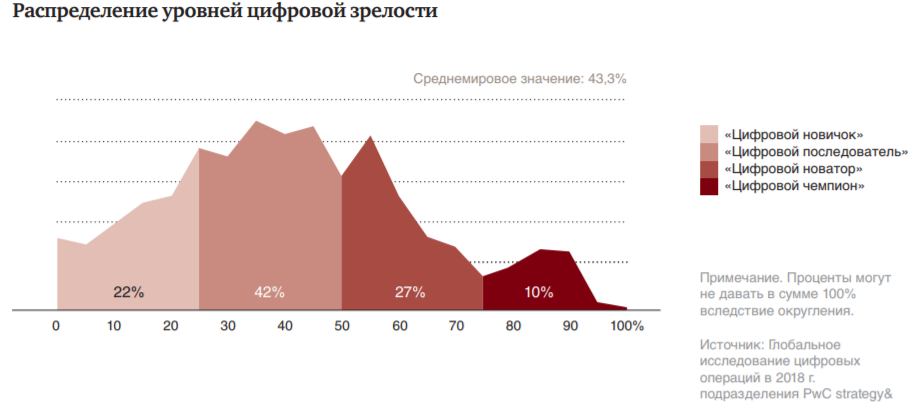
Two thirds of all surveyed companies are at the initial stage of transformation or have not yet begun this process. Only 10% of manufacturing companies can offer a well-established list of innovative, digital products. The main part of this minority is in the electronics and automotive industries (14% and 20%, respectively).
The center of digitalization is the Asia-Pacific region. A key factor in the emergence of 19% of the Digital Champions companies surveyed is the rapid increase in production costs and digitalization costs which force companies to adhere to this trend and remain competitive.
Digital Leaders strive to integrate the Operating, Technological, and Human Resources ecosystems in order to serve customers while using innovative and complex approaches More than 75% of such companies show high results in the ecosystem of Customer solutions and in the Operating ecosystem.
Leaders in digitalization are introducing new technologies to strengthen the connectedness of the value chain. These technologies include: integrated end-to-end supply chain planning (adopted by 87% of Digital Champions), Industrial Internet of Things (78%), production management systems (75%), cobots (collective robots) and intelligent robots (72%), and also solutions for predictive diagnostic services (70%). It is expected that with the introduction of these technologies, in the future this will lead to cost savings of 16%.
The introduction of artificial intelligence contributes to the adoption of operational decisions but many companies are experiencing incertitude due to the lack of staff for the successful implementation of a system based on artificial intelligence. By 2030 the digitalization is expected to provide the increase of GDP up to 14%, or by $ 15 trillion USD equivalent as of today. There will be a growing demand for skilled labor in the field of digital technology. It is essential to create incentives to increase the amount of investments in the development and training of employees, retraining.
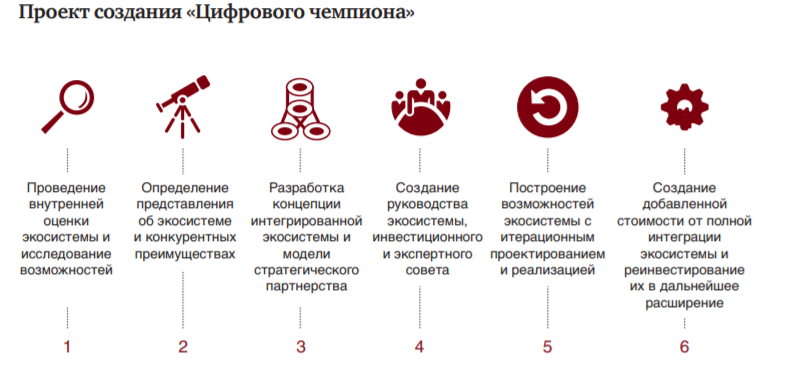
The starting point on the path to becoming a «Digital Champion» is a comprehensive view of the ecosystem and the formation of a competitive offer. Companies benefit from the use of fully integrated ecosystems by continually investing in the continual expansion and by improving their ecosystems of the Customers Solutions, Operating, Technological and Personnel ecosystems.