Invest in Russia — invest in Russian regions!
All analytics

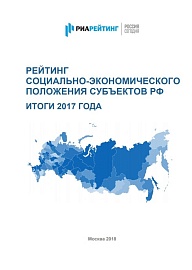
Ratings of Socio-Economic Development of the Constituent Entities of the Russian Federation in 2017

Research
14 February 2019
Рейтинг социально-экономического положения субъектов РФ: итоги 2017 года
Source
Release date
05/23/2018
Open PDF

Russia is notable for an extreme non-uniformity of economic development. Regions of Russia vary in size, climatic conditions, and time zones, which poses different challenges to regional authorities. The Ratings of Socio-Economic Development of the Constituent Entities of the Russian Federation provide a basis for assessing the regions’ investment appeal and a reference point for identifying challenges that shape the regions’ further development paths. The research is based on official statistics from open sources and was conducted for the eighth time.

The socio-economic position of the constituent entities of the Russian Federation is determined by two groups of factors. The first group is composed of objective factors — ranging from availability of natural resources, historically established infrastructure, and natural and climatic conditions to the mentality of local people. The second group comprises subjective factors, such as regional strategies, economic policies, and business environment. Notably, the factors of the second group can either contribute to the region’s rating or inhibit its growth. If regional authorities use the available natural resources wisely, the region performs well. If the economic policy is deficient, the region’s rating will fall, despite all the objective advantages the region might have. For this reason, it’s essential that the region’s benefits are used efficiently.

The ratings are calculated by aggregating key indicators of regional development. For each region, the rating reflects its individual level and highlights disproportions in its social development. Besides, such ratings increase transparency of federal and local authorities, as well as of local businesses, which ultimately has a positive impact on regional development.
Anlytics on the topic

All analytics
Research
2 July 2020
Safely Learning during COVID-19 Pandemic: Guidelines for Preventing Violence Against Children in Education

A joint study by experts from a number of international organizations (UNESCO, UNICEF, World Bank, WHO, etc.) is devoted to the issues of ensuring a safe educational environment in the current conditions of distance learning for children and social distancing caused by the COVID-19 pandemic and its consequences.

Research
13 February 2018
Annual Report of the Arctic and Antarctic Expert Advisory Board at the Federation Council (2016)

The Arctic and Antarctic Expert Advisory Board at the Federation Council of the Russian Federation prepares an annual report On the State and Problems of the Legal Framework for the Development Strategy of the Arctic Zone of the Russian Federation and National Security up to 2020. On the State and Problems of the Legal Framework for Russian Scientific Activities in the Antarctic.

Articles
25 October 2018
Russia-2024: The strategy of social and economic development

In his article published in Voprosy Ekonomiki, Dmitry Medvedev, Chairman of the Government of the Russian Federation, analyzes the goals of Russian social and economic policy for 2018–2024, in particular those in the areas of education and science, healthcare, social policy, technologies, finance, and exports.

Articles
31 October 2019
The Middle Class Formation and Development Problems in a Changing World

Now the theory of the middle class conflicts with world practice. The middle class is understood as the majority group of the population, which, on the one hand, has high social stability and tends to stabilize the formed social environment, and on the other hand, forms a request for modernization and transformation of the socio-political and economic structure. At the same time, the crisis of the neoliberal and globalization paradigm, the growing inequality in the world raises questions of rethinking the conditions of formation and development of the middle class.