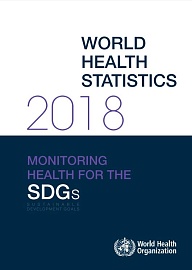
The World Health Statistics report published by the World Health Organization (WHO) provides a summary of the current status of selected health-related targets of the Sustainable Development Goals (SDGs) in the form of an analysis of statistics for health-related SDG indicators. The publication presents comprehensive statistics at country, regional, and global levels. However, the authors acknowledge that to ensure readability, the report does not include the margins of uncertainty.
First, in order to improve understanding and interpretation of the data presented, Part 1 of the report outlines the different types of data used and provides an overview of their compilation, processing and analysis. In Part 2 summaries are provided of the current status of selected health-related SDG indicators at global and regional levels, based on data available as of early 2018. These health-related indicators are grouped into the following seven thematic areas: reproductive, maternal, newborn and child health; infectious diseases; noncommunicable diseases (NCDs) and mental health; injuries and violence; universal health coverage (UHC) and health systems; environmental risks; health risks and disease outbreaks.
In Part 3, each of the WHOs three strategic priorities of achieving universal health coverage (UHC), addressing health emergencies, and promoting healthier populations is illustrated through the use of highlight stories, such as increasing the coverage of essential health services, reducing the number of cholera deaths, and addressing the problem of child and adolescent obesity. For example, statistics show that although high-income countries continue to have the highest prevalence of obesity, the rate at which obesity among children and adolescents aged 5¬19 years is increasing is much faster in upper-middle-income countries. Notably, the number of obesity cases in low-income countries has been steadily growing too since early 2000s.
.png)
In addition, for each of the strategic priorities, the report enumerates challenges and risks which must be addressed in order to achieve the SDGs. The risk factors include rising social inequality, unsafe drinking water, lack of adequate sanitation and hygiene, unhealthy nutrition, lack of adequate physical activity.
This publication has been posted in the Roscongress Information and Analytical System on the recommendation of the Roscongress Foundation expert community.