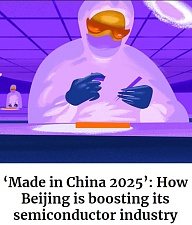
As part of the «Made in China 2025» plan, the Chinese government has set its semiconductor industry a goal of reaching US$305 billion in output by 2030, and meeting 80 per cent of domestic demand. To compare, in 2016, China produced US$65 billion worth of semiconductors and supplied 33 per cent of the domestic market.
Semiconductors are essential to all electronic equipment, including smartphones, computers, cars, industrial robots, and military and aerospace equipment. The authors of the article differentiate between two production models: a) the Integrated Device Manufacturer (IDM) model, when a single firm carries out all of the production stages: design, manufacturing, assembly, testing and packaging; and b) the Fabless-Foundry model, when the production process is split among companies. Due to the current global division of labour, the making of a semiconductor usually involves several countries. The value chain has become increasingly dispersed across the world: most IDMs and design («fabless») firms are based in the US and South Korea, while foundries (manufacturing companies) and OSAT (Outsourced Semiconductor Assembly and Test) firms are concentrated in Taiwan and China.
.png)
The design work is currently the fastest-growing segment of the Chinese semiconductor industry. The sectors distinguishing feature is the concentration of production sites in the economically more advanced eastern regions of the country.
As for global consumption, China now consumes more than half of the worlds chips. The countrys surging demand for chips in the past two decades has fuelled the growth of the global semiconductor market.
.png)