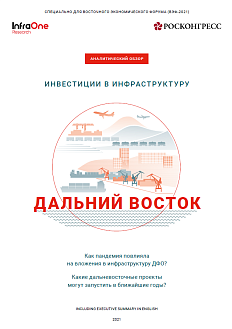
In their review, InfraOne experts state that the economy of the Far East is better developed than that of the North Caucasus, but the Far Eastern Federal District lags behind the remaining federal districts of the Russian Federation, both in terms of GRP and the volume of investment in fixed assets, as well as infrastructure expenditures. The picture is unlikely to change significantly in the next year or two, but in the longer term, if large industrial investment projects are successfully launched, the region has a good chance to break out from second-to-last place. This will be aided by the fact that in the Far Eastern Federal District there are enough resources for the development of mining and local large-scale industries, and nearby there is a large sales market in the countries of the Asia-Pacific region.
.png)
Infrastructure expenditures in budgets of the Far Eastern regions in 2017 did not exceed RUB 85 bn, or 2% of GRP of the district. This proportion is comparable with that of the country overall. Despite a slight forecasted growth in infrastructure expenditure of the district in the next two years (with part of the expenditure covered by funds that will be allocated to finance the objectives set out in the Decree of the President adopted in May), this wont cover the needs of the district.
These measures will not reduce the imbalance in the development of infrastructure within the federal district: for instance, Sakhalin region is the leader in terms of inward foreign direct investments in the Far East (89% of all foreign investments in the district). The report also describes industrial subindexes used in calculating the Infrastructure Development Index for each region of the federal district. Most of all, the Far East lags behind the all-Russia indicators for the development of transport and energy sectors. In terms of the development of social infrastructure, the districts indicators are, on the contrary, higher than the average in Russia. The market majors interest in the region is likely to shift towards port and rail infrastructure, where four to five major investment projects will probably be launched in the same period.
.png)
InfraOne points to a high investment potential of the district due to an excess of liquidity maintained by large Russian investors and a flow of initiatives on the market. However, despite the excess money, it is still a challenge to get funding for a project: majors of the market are focused on high-quality investments which appear in the district much less often than in the Western regions of the country. In addition, local authors of projects are focused mainly on bank financing and thus cut themselves off from other opportunities to raise money for example, to issue concession bonds or to sell a stake in a project. Besides, in the Far East, traditionally more projects are discussed in the social sphere and other areas that do not require large capital expenditures and budget participation (telematics, IT and telecommunications).