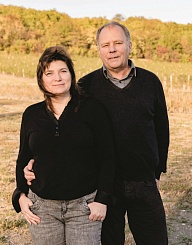
The Burnier family have cultivated grapes and produced wine in Switzerland for more than four centuries. Their viticulture operation expanded to Russia in 2001. Renaud had often heard professors at the College of Oenology at Changins, from which he graduated, describe the south of Russia as an ideal location for growing grapes. He became convinced of that himself in 1998, when he first travelled with his wife to Krasnodar Territory.
The first grape Renaud sampled in Russia was a Krasnostop. It was a taste of his destiny. Experienced winemakers can determine the potential of a wine by the flavour of the grapes. Renaud was so impressed by the uniqueness of the variety and the possibilities it offered that he immediately decided to find land where he could plant a vineyard, including, of course, the Krasnostop Zolotovsky variety.
It took three years to find the perfect plot. The BURNIER vineyard is located in Natukhayevskaya, outside Novorossiysk. Bordeaux and Piedmont are at the same latitude. The vines grow on a sunny southwestern slope which is well ventilated, helping to prevent disease. «The land itself tells us that the wine that can be made here is comparable to the best in the world,» Marina Burnier says. «Renaud and I want the whole world to know that excellent wines can be made in Russia.»
However, finding Krasnostop seedlings proved to be a problem. They were able to purchase several thousand plants in Rostov Region, but not all of them were of a good enough quality. So the Burniers started their own nursery and began working on selection. Over the course of several years, expert Swiss ampelographers came to select the best vines according to more than 20 criteria. This lengthy and painstaking process helped to preserve the Krasnostop Zolotovsky variety of grape as part of Russia’s natural heritage.
Burnier also used high-quality cloned seedlings brought from Italy and France to establish his vineyard: both white (Chardonnay, Pinot Blanc, Pinot Gris, Yellow Muscat, and Viognier) and red (Merlot, Cabernet Sauvignon, Cabernet Franc, Malbec, and Syrah).
Establishing a distribution system was even more difficult. «In Russia, there is no way to freely store, move, and sell wine, as is customary, for instance, in Switzerland. Those activities are strictly regulated by the state. Small producers cannot afford their own licensed warehouses in different cities around the country, so they end up wholly dependent on distributers and importers, who have no interest in promoting Russian wine due to low margins,» explains Marina. She believes that developing high-quality domestic wine production in Russia will require making it possible for producers to sell their own products regardless of where they are licensed. And for that to happen, businesses producing wine from their own grapes will need to be regulated as a separate class.
The Burniers’ first 17 hectares of grapes were harvested in 2005. Over the decades, the Burnier family had collected a circle of dedicated clients in Switzerland, and those customers were excited to sample the wine Renaud was making in Russia. The results delighted everyone. The success of that first vintage led them to expand the vineyard to 50 hectares by 2008. And in 2009, the first deliveries were sent to Europe. Today, the operation exports 15–20 % of what it produces, and not only to Switzerland, but also to the United Kingdom, Germany, France, and even China.
«We frequently hold tastings for our Russian wines in various European capitals,» says Marina. «The first response is always surprise: Russia is not all snow. You can have a vineyard there, too. That surprise gives rise to an even greater curiosity. Renaud likes to tell people at these tastings to ‘taste the Russian land’. And when they try our wine, they’re amazed by the potential and structure the Russian terroir gives it.»
International experts say wine from Krasnodar Territory is comparable to the top varieties from Bordeaux and Tuscany. And it is much less expensive. The Burniers run a full-cycle enterprise. Cultivating and processing the grapes, producing and ageing the wine, bottling — all of these steps happen in one place. Renaud is opposed to high-tech methods of wine production, and he uses only traditional, environmentally sound techniques. That means the BURNIER line contains no simple or young wines, only wines that are well aged, and as high-quality and natural as possible, delivering the full taste of the grapes and the terroir. In Russia, connoisseurs can enjoy them in the best restaurants of Moscow, Sochi, and, of course, St. Petersburg.
INDEPENDENT WINEMAKERS
Today, Domaines Burnier is the only winemaking enterprise in Russia that meets all the standards of the European Confederation of Independent Winegrowers (CEVI). This authoritative organization, headquartered in Paris, brings together small, independent European winemaking enterprises. Burnier hopes to create a similar organization in Russia, which would be an important step in giving the country a voice in the international winemaking community.
Source: SPIEF-2018 Official Magazine