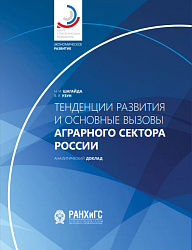
Russian agriculture is growing even in crisis conditions as against other economic industries. Owing to the production growth Russias GDP from agriculture increased from 3.5% in 2012 to 4.5% in 2016. The agrarian reform adopted in the 1990s of the 20th century was a key factor of agriculture development in the country. It made it possible to transfer lands and properties to more efficient owners and raise investments. State support and interest on the part of business allowed for modernisation which contributes to the growth of products in many industries.
Import substitution policy led to that from 2013 to 2016 the share of imported retail food products dropped from 36% to 23%. At the same time the share of exports increases quickly (share of food exports increased from 1.6% in 2000 to 6% in 2016, it took the fourth place followed by oil and gas, metal and chemical products in the export structure). If these trends remain the same, the industry may become a net exporter of food products in the nearest years.
However, there are some barriers to further development: limited domestic demand, non-competitiveness of most products, underexploitation of the agricultural potential due to irregular agricultural structure and less good conditions created for agricultural manufacturers than those observed by competitors. The agricultural structure built in Russia is not normal for the global practice.
Of 21 thousand agricultural companies incorporated in Russia 350 companies produce 46.5% of goods. Only 4% of products are manufactured by 61% farms but they own 27% of agricultural lands and engage about 12% of employees. The smallest archaic farms yet produce 35% of products. The concentration becomes hypertrophied: one agricultural holding controls not only a separate region but several regions. This is partly due to unequal access to subsidised credit resources and other forms of state support. The bulk of non-holding companies are deprived of government subsidies.
Thus, 50% of agricultural organisations do not receive or receive little support (1.5% of subsidies and 8% of revenues), while 5 agricultural organisations could get 6% of subsidies (with 3% of revenues) (2015). The selection of projects is subjective, one company can get up to 90% of the financing for individual areas. Only in 2017, the first steps were taken to limit support to one recipient of subsidies.
However, there are no restrictions for the holding involving several recipient organisations. Thus, the state funds owners of large private companies on a non-repayable basis. It can be said that individual private companies in Russia receive unprecedentedly high support, which give them competitive advantages and drives out small businesses.
According to the CSR, in order to avoid negative consequences, it is necessary to make key transformations and move to the model of qualitative sustainable development:
1. From the traditional orientation to the growth of production in all sectors to the integration of the country into the international differentiation of labour. For industries that can be competitive in the future direct support for their modernisation and reducing barriers to their business:
2. From stimulating the growth of volume indicators to the increase in the competitiveness of Russian products as a routine concern of the state (eliminating barriers to lands, loans, administrative barriers, overcoming monopolistic behaviour of suppliers, modernisation of agricultural science and education...):
3. Transition from the priority of food security as food independence to the priority of economic access to safe food products:
4. From the archaic living conditions in the village to the increase in the attractiveness and quality of life in rural areas. 
Close