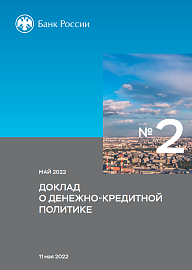
The report by the Central Bank of the Russian Federation contains a detailed analysis of principal trends in the Russian economy and the process of setting the country’s economic agenda.
The Roscongress Foundation presents the salient points of the publication accompanied by fragments of broadcasts of relevant panel discussions from the business programme of international events held by the Roscongress Foundation.
Several factors influenced the Bank of Russia’s decision to decrease the key rate to 14%.
On April 29, 2022, the Bank of Russia decreased the key rate to 14% per annum. According to Bank of Russia Governor Elvira Nabiullina, there were several reasons behind this decision. Firstly, inflationary pressure and inflation expectations are declining. The evidence for this is that households’ soaring demand has diminished and the ruble has strengthened. Secondly, economic activity is declining, with supply contracting more significantly than demand. This is what provokes inflationary pressure at the moment.
Bank of Russia Governor states that during this period monetary policy should take into account the processes of adaptation and structural transformation in the economy which inevitably involve a temporarily higher level of inflation. This is why the Bank of Russia has no intention to quickly bring inflation back to the target as this would lead to a shortage of goods.
Monetary conditions remain tight. On the one hand, both the ruble exchange rate and yields on federal government bonds returned to the level of mid-February. Financial stability risks lowered. On the other hand, the risk premium included in credit rates edged up. Also, banks’ requirements for borrowers and collaterals are stricter today. The decrease in the key rate, the Bank of Russia says, will help alleviate this situation.
The Bank of Russia’s macroeconomic forecast is cautious.
The Bank of Russia considers that the scenario where proinflationary factors and risks prevail is the most probable one.
The termination of long-term economic relations will have a negative impact on GDP this year. GDP will decline by 8–10%, dropping to the lowest point in the fourth quarter. A gradual decrease in demand and supply shocks, monetary policy, fiscal policy, as well as structural measures implemented by the Government will promote the recovery of economic growth since the beginning of next year. Due to the high base of the first quarter of 2022, the overall change in GDP next year as compared to the entire 2022 will range from zero to minus three percent. The Bank of Russia expects GDP to expand by 4–5.5% by the end of 2023, as compared to the end of this year.
The same is true for household consumption. Although consumption will decline in 2023 against the overall figures of 2022, it will be 4.5–6% higher in the end of next year than in the fourth quarter this year.
Gain more insights about economic policy and banking in the Financial market, Economic progress, and Monetary policy sections of the Roscongress Information and Analytical System.